Objectives
After studying this module, you should be able to:
- enumerate the four major paradigms through which the problem of underdevelopment is analyzed; and
- determine the subordinate and superordinate influential factors of the underdevelopment problematique from each major paradigm.
Activities
Read Chapter 4 of your text.
In Chapter 2, we attempted to draw a problematique map and to trace its superordinate influential factors. The configurations in this map as well as the root causes identified would depend to a large degree on the perspective that we adopt.
As discussed in Chapter 4, there are four major paradigms used in analyzing underdevelopment, namely: the technological paradigm; the economic paradigm; the structural paradigm; and the values paradigm.
- Activity 4.1. From the technological point of view, draw the underdevelopment problematique.
- Activity 4.2. From the economic point of view, draw the underdevelopment problematique.
- Activity 4.3. From the structural paradigm, draw the underdevelopment problematique.
- Activity 4.4. From the values paradigm, draw the underdevelopment problematique.
Answers

Technological Paradigm
The Technological Paradigm views the problem as a result of a deficit in modern technical inputs, knowledge, and infrastructure.
|
Subordinate Factors |
Lack of Modern Paving Technology |
Insufficient local expertise in specialized road engineering, drainage construction, and quality control. |
|
Insufficient R&D on Coastal Pavements |
Lack of locally-adapted scientific research to develop cost-effective, durable road mixes for the unique tropical, saline environment. |
|
|
Low Skilled Technical Labor |
Insufficient local expertise in specialized road engineering, drainage construction, and quality control. |
|
|
Superordinate Factors |
High Road Maintenance Costs |
Frequent, expensive repairs are needed because the initial technology was inadequate for the environment. |
|
Dependence on Imported Technical Experts |
The Islands must continuously pay foreign consultants and engineers for expertise that is not locally available. |
Economic Paradigm
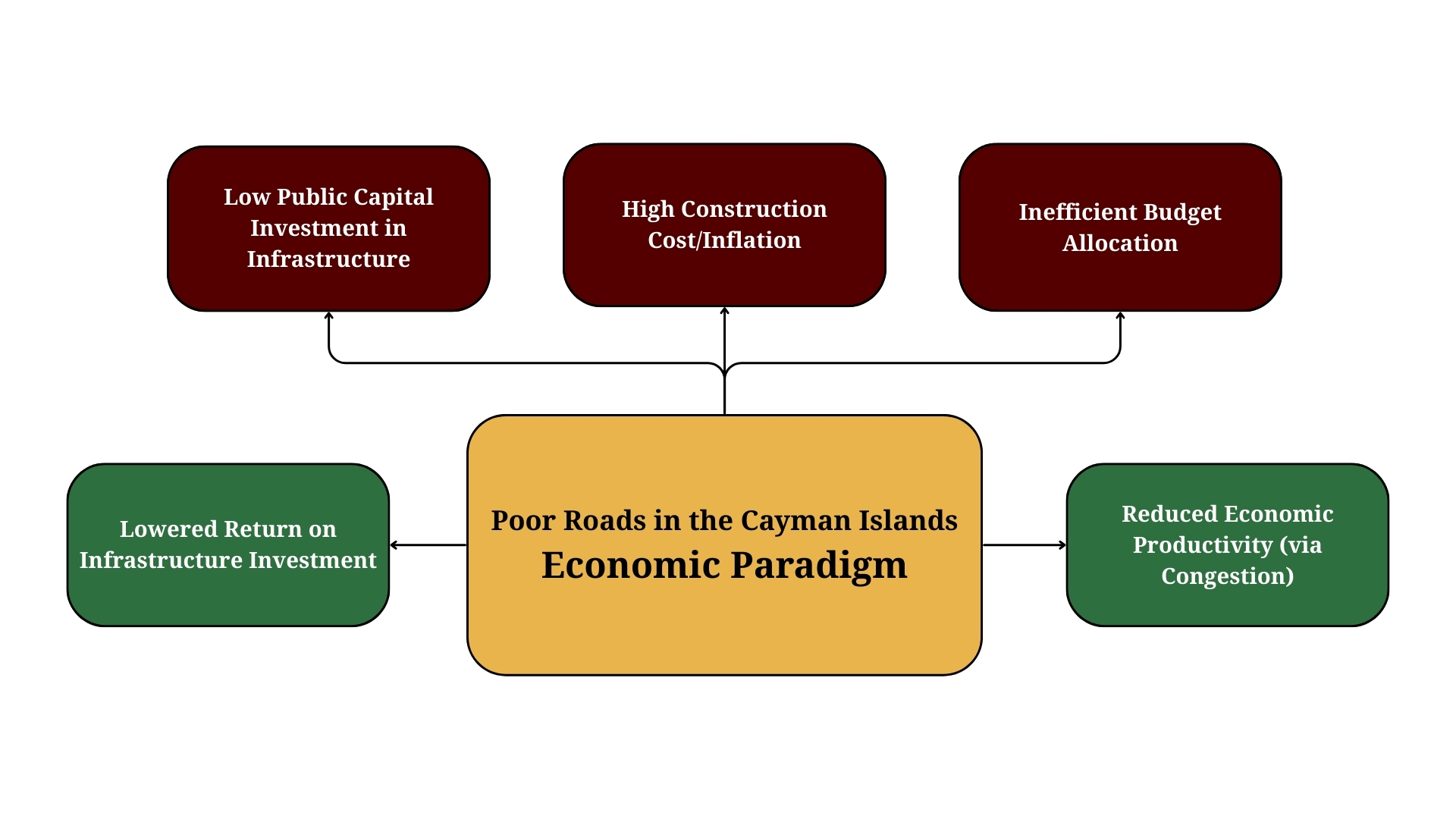
The Economic Paradigm views the problem as a failure of capital accumulation, investment, and efficient resource allocation.
|
Subordinate Factors |
Low Public Capital Investment in Infrastructure |
The primary issue is a lack of sufficient funds allocated from the national budget for major road construction and multi-year maintenance plans. |
|
High Construction Cost/Inflation |
The high cost of labor and imported materials consumes the budget quickly, preventing large-scale projects. |
|
|
Inefficient Budget Allocation |
Funds are spent on short-term repairs rather than high-return, long-term capital projects (e.g., proper drainage systems). |
|
|
Superordinate Factors |
Reduced Economic Productivity (via Congestion) |
Traffic delays caused by poor roads act as a tax on the economy, costing businesses and workers time and fuel. |
|
Lowered Return on Infrastructure Investment |
Poor quality roads mean the national investment decays faster, requiring repetitive spending. |
Structural Paradigm
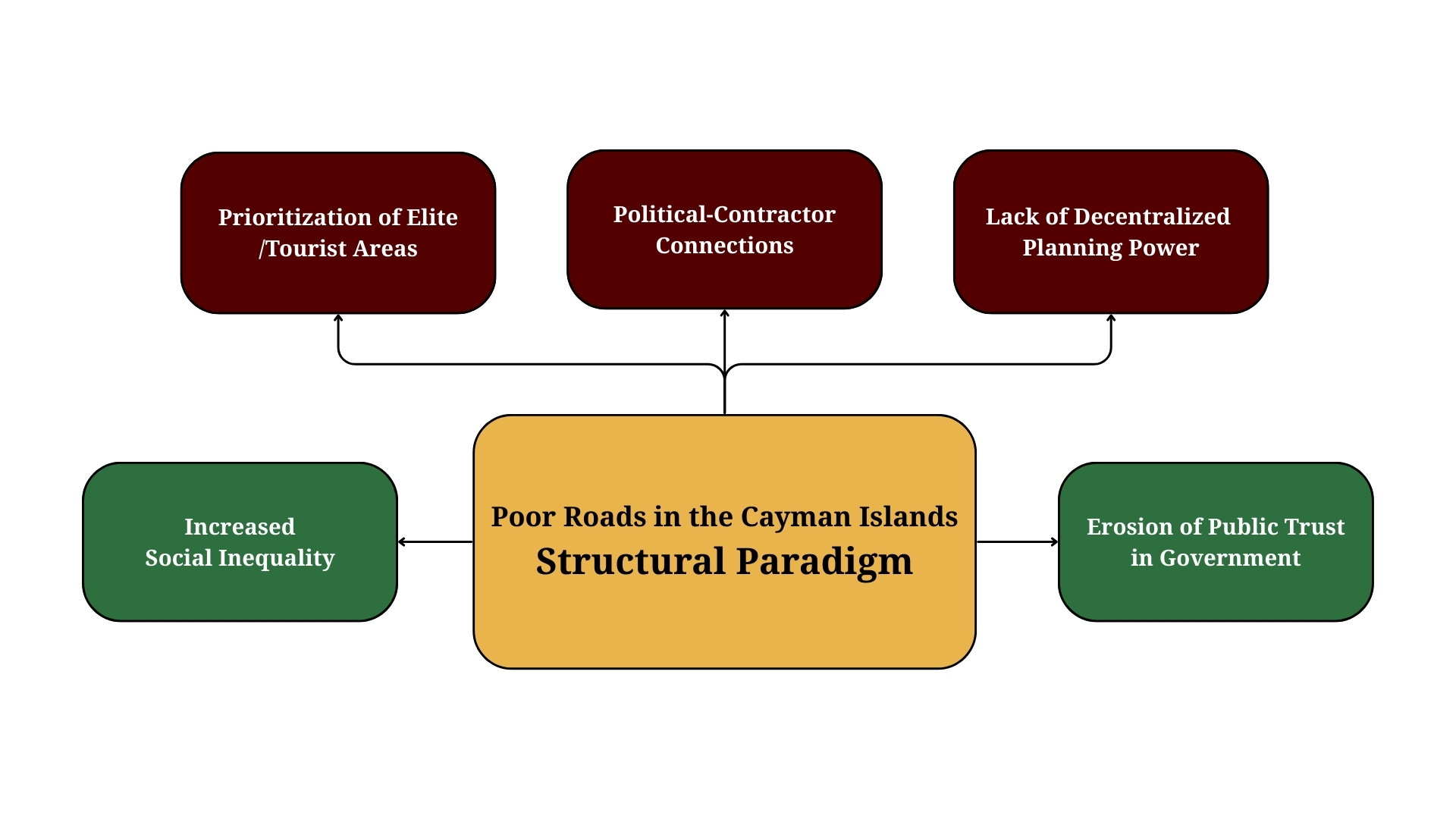
The Structural Paradigm views the problem as a symptom of unequal power relations, often between social classes or between the local government and foreign commercial interests.
|
Subordinate Factors |
Prioritization of Elite/Tourist Areas |
Political decisions disproportionately fund and maintain roads leading to high-end resorts and financial centers, neglecting roads in lower-income residential areas. |
|
Political-Contractor Connections |
Contracts are awarded based on political ties rather than quality or best price, leading to substandard work and quick road degradation. |
|
|
Lack of Decentralized Planning Power |
Local needs and priorities in the Sister Islands (Cayman Brac/Little Cayman) are structurally neglected in favor of Grand Cayman’s central administration. |
|
|
Superordinate Factors |
Increased Social Inequality |
Poor road access limits opportunity for those in marginalized areas, impacting school access, job travel, and emergency response times. |
|
Erosion of Public Trust in Government |
Citizens view the continuous poor road quality as evidence that the system is corrupt or only serves vested interests. |
Values Paradigm
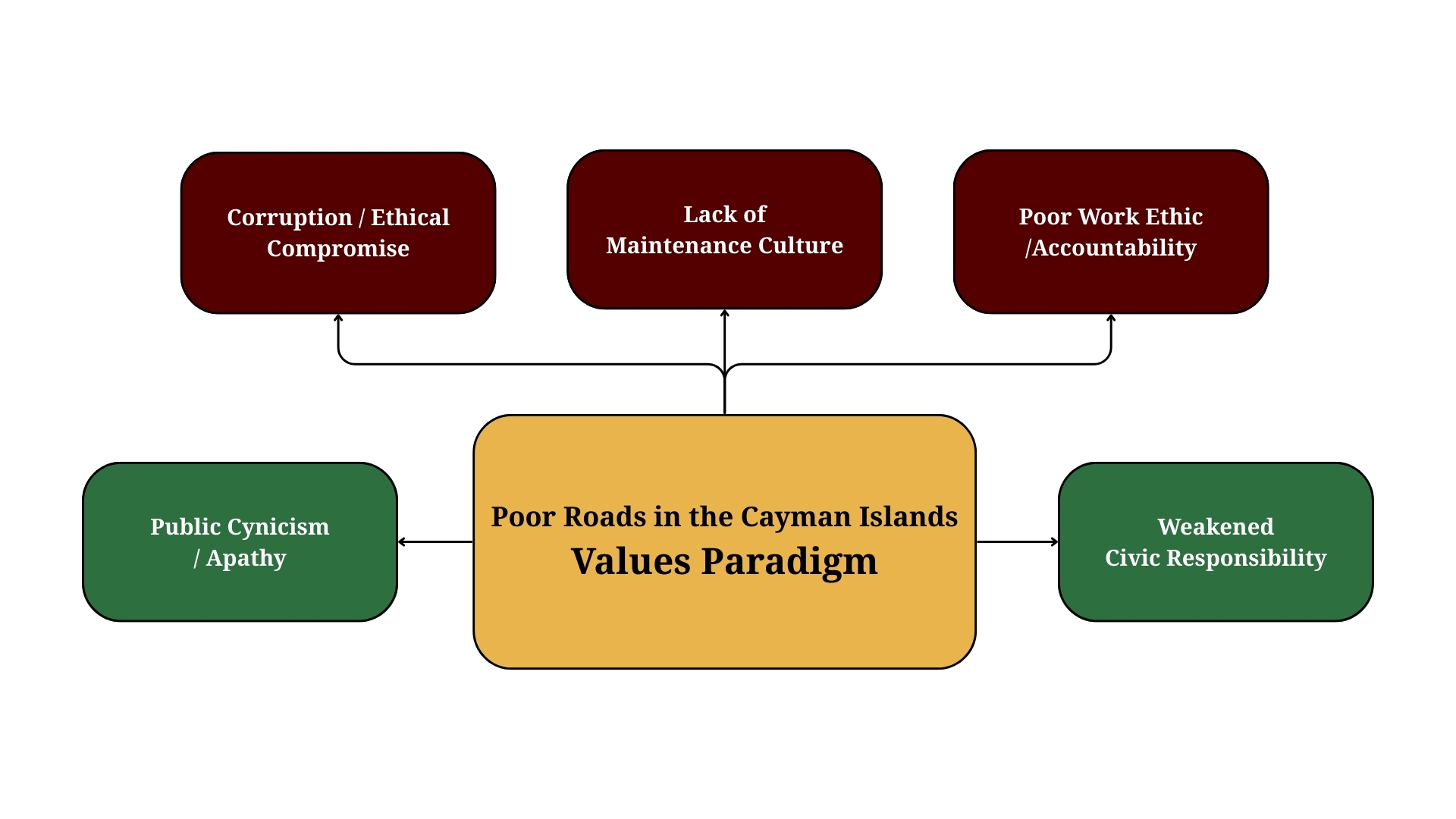
The Values Paradigm views the problem as rooted in cultural, behavioral, and ethical shortcomings, where collective responsibility and modern organizational values are weak.
|
Subordinate Factors |
Lack of Maintenance Culture |
A cultural norm that emphasizes new construction (glamour) over meticulous, routine maintenance (preventative care), allowing minor defects to become major failures. |
|
Poor Work Ethic/Accountability |
Ineffective monitoring and lack of pride/commitment among public works crews and contractors, leading to low-quality repairs that don’t last. |
|
|
Corruption/Ethical Compromise |
Public officials or inspectors accept bribes or fail to enforce quality standards, driven by personal gain over public good. |
|
|
Superordinate Factors |
Public Cynicism/Apathy |
Citizens adopt a fatalistic view (“The roads will always be bad”), leading to inaction and a failure to hold officials accountable. |
|
Weakened Civic Responsibility |
The general public contributes to the problem through littering or abusing the roads, viewing it as “the government’s problem” rather than a shared asset. |